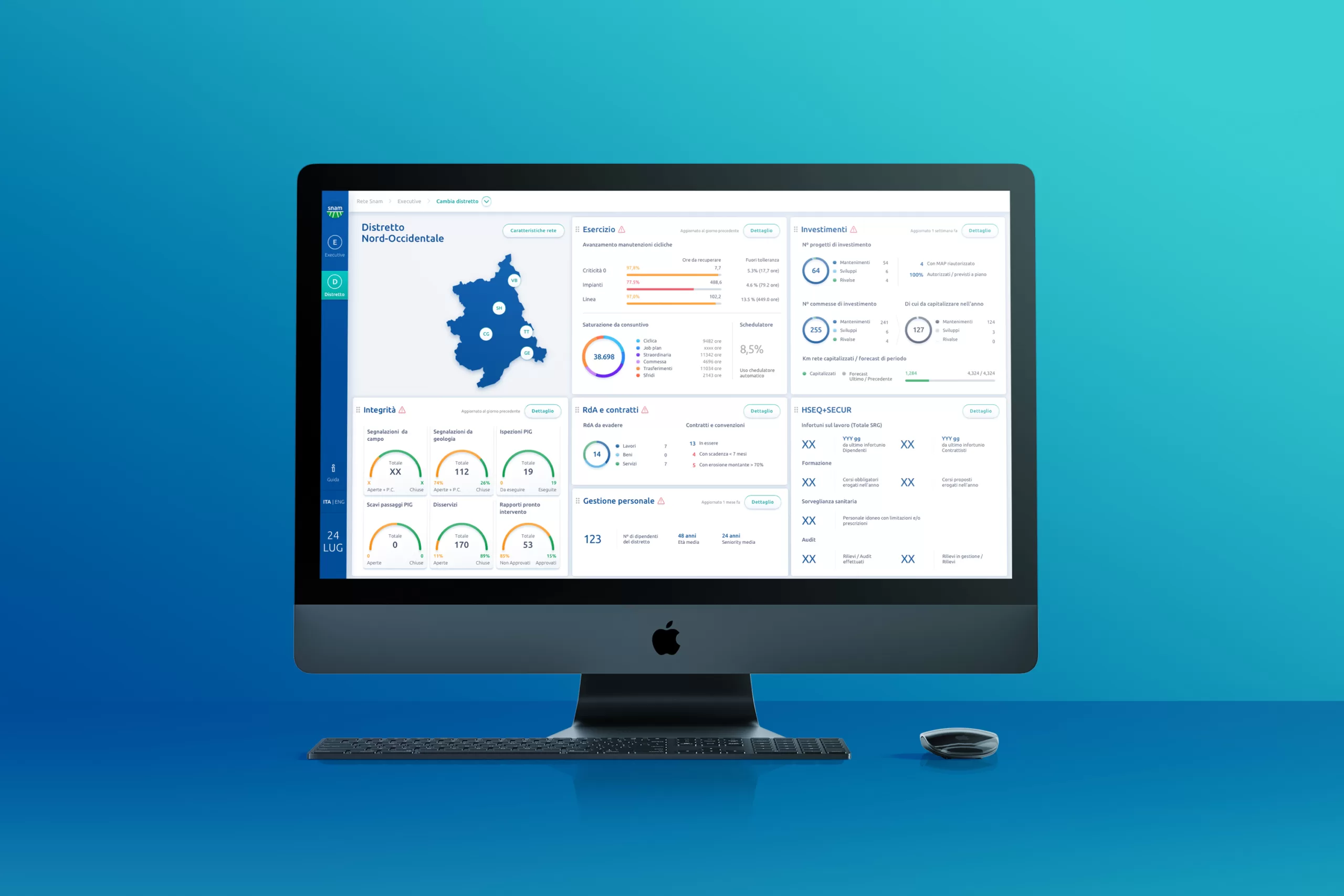
A decision making dashboard
The SNAM Control Tower project emerged as part of the company’s broader digital transformation initiative. SNAM is the biggest buyer and supplier of gas in Italy, with a focus on the B2B market. SNAM is the main Italian operator for the transport and dispatching of natural gas in Italy, having almost all the transport infrastructures in Italy, with 32,862 km of gas pipelines in operation.
Given the scale and complexity of managing such critical infrastructure, the need for a unified data visualisation system became paramount.
In the context of digital transformation through Scrum, an Agile teamwork method, we developed a digital platform that allows managers to easily visualise a series of KPIs and metrics in order to help them take faster decisions.
I had the double responsibility to create the UX flow and design the UI interface of the platform as part of the working unit, together with the people of SNAM and Boston Consulting Group.
Complex Collaboration and Discovery Phase
This was a very complex project to be developed in a couple of months. We worked together with management and people of BCG to understand the issues, needs and priorities of data visualisation for SNAM infrastructure.
The dashboard layout should be designed to present data in a quick, easy-to-scan format with the most relevant information understandable at a glance. The challenge was understanding not just what data to show, but how different management levels needed to interact with that data to make operational, tactical, and strategic decisions.
The mechanics of the work were lengthy workshop sessions with different stakeholders depending on the area of data or user stories. These sessions brought together C-suite executives, regional managers, district operators, and technical teams, each contributing their perspective on what information mattered most for their decision-making processes.
Tricky Usability Challenges
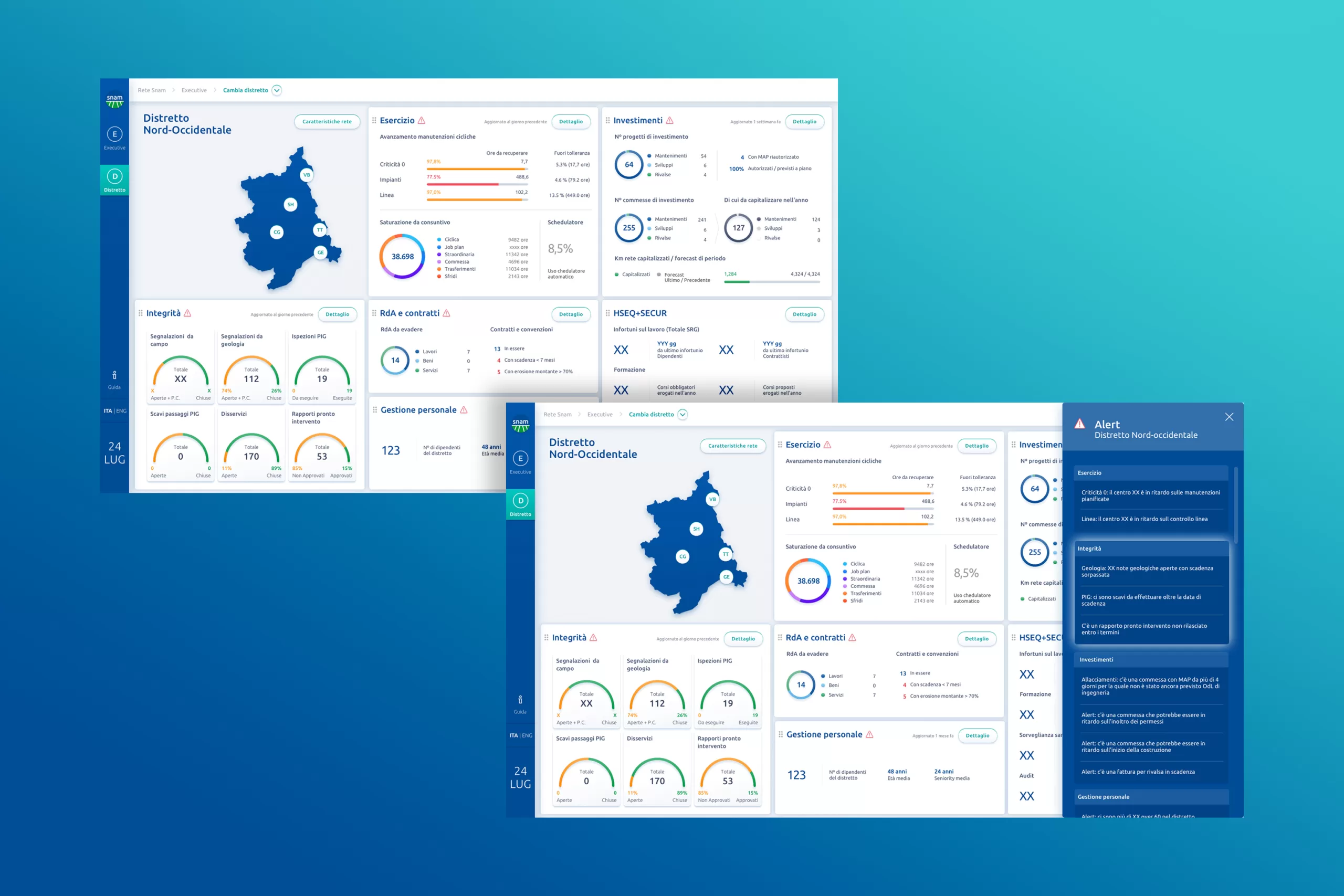
There were some tricky usability things such as the identification of specific alert colours that mean different things for common people but were standard in the industry. Use colour to differentiate categories and indicate relationships between data points, and reserve bright colours for highlighting anomalies or urgent information that requires immediate attention.
For example, certain colour codes in the gas industry carry specific operational meanings that differ from general UX conventions. We needed to balance industry standards (which SNAM operators understood intuitively) with usability best practices (which ensured new users could onboard quickly). This required extensive testing with actual operators to find the right balance.
Backend Data Integration Complexity
Also, trying to understand how to better recollect information meant there was also great work on backend coding because data platforms were different and the methodology of data collection was also different, so we had to create a data converter to align and consolidate such information.
We integrated data sources across systems, like project reports, financial data, IT and asset tickets, creating a unified data stack. SNAM’s infrastructure spanned decades of implementation, meaning data existed in legacy systems, modern platforms, and everything in between. Creating a unified view required sophisticated data architecture work happening in parallel with UX design.
Three-Level Dashboard Architecture
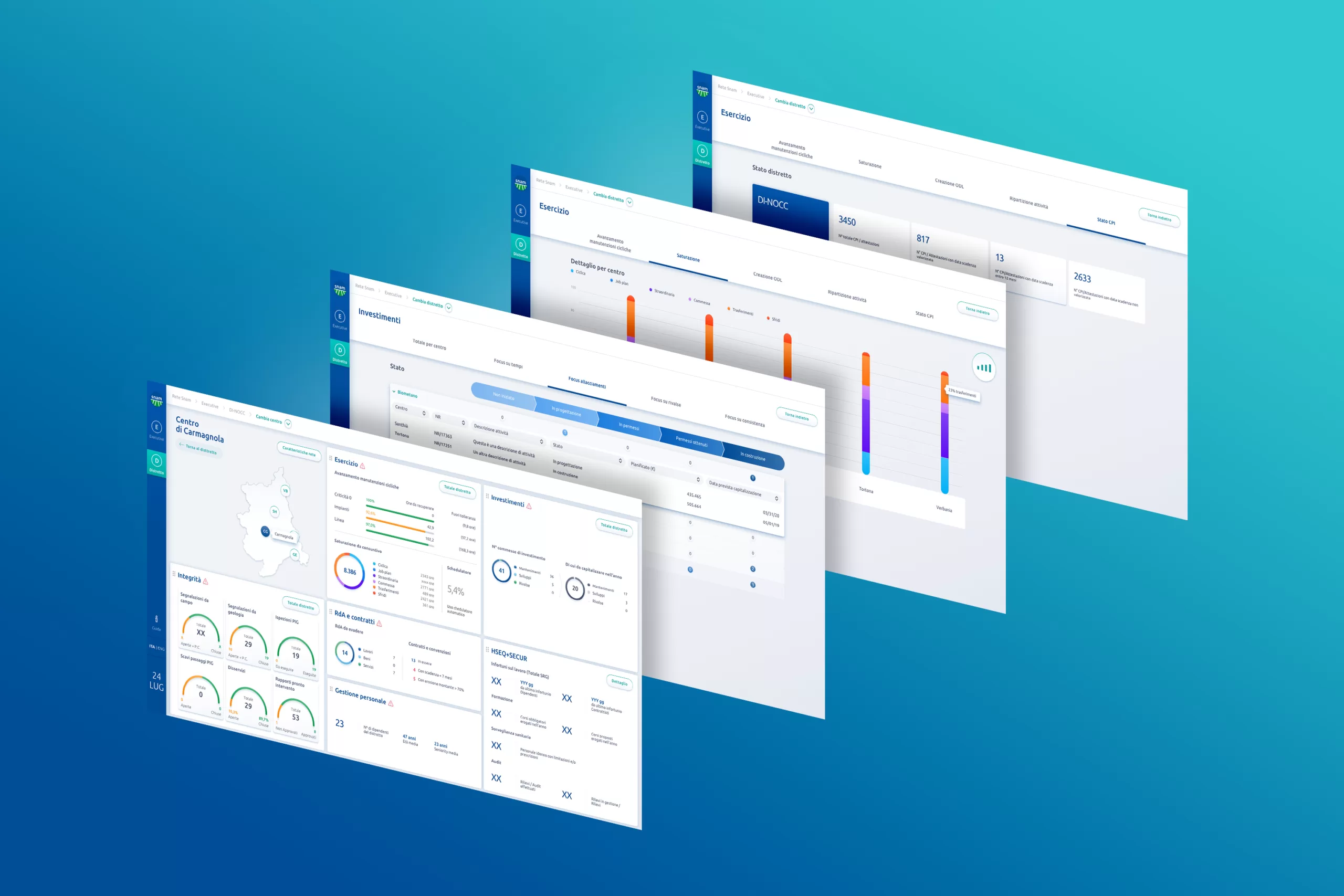
The dashboard has different levels. The main dashboard provides general visualisation of SNAM infrastructure system over the country with key metrics, ideal for C-management. Dashboards can be customised to cater to different stakeholders within an organisation, providing relevant insights and information tailored to their specific roles and responsibilities.
Then by regions for senior management, and finally districts and centres for operative management. This hierarchical structure meant that each user role saw exactly the information they needed without overwhelming cognitive load. KPIs are the most critical measurements of success, whilst metrics provide context and additional details around those KPIs.
You could also access detailed trends and other specific information to improve process and sustainability. The drill-down capability allowed managers to start with high-level overview and progressively explore granular data as needed, following their decision-making process naturally.
Building on SNAM Collaboration
After working on the SNAM Control Tower, I continued my collaboration with SNAM on another important project: Io Vado a Metano, demonstrating the successful partnership established through this complex dashboard implementation.
The Control Tower project proved that with proper collaboration between UX designers, backend developers, industry experts, and management consultants, it’s possible to create data visualisation systems that genuinely improve decision-making speed and quality for critical infrastructure operations.
Project Vitals
Client: SNAM (Società Nazionale Metanodotti)
Collaborator: Boston Consulting Group (BCG)
Project: Control Tower Dashboard System
Role: UX Designer, UI Designer
Services: UX Flow Design, UI Interface Design, Data Visualisation Strategy, Usability Testing, Workshop Facilitation
Methodology: Scrum (Agile)
Technical Scope: Backend data integration, data converter development, multi-platform consolidation
Duration: 2 months intensive development (2018-2019)
Client
Snam
Agency
Alkemy
Country
Italy